

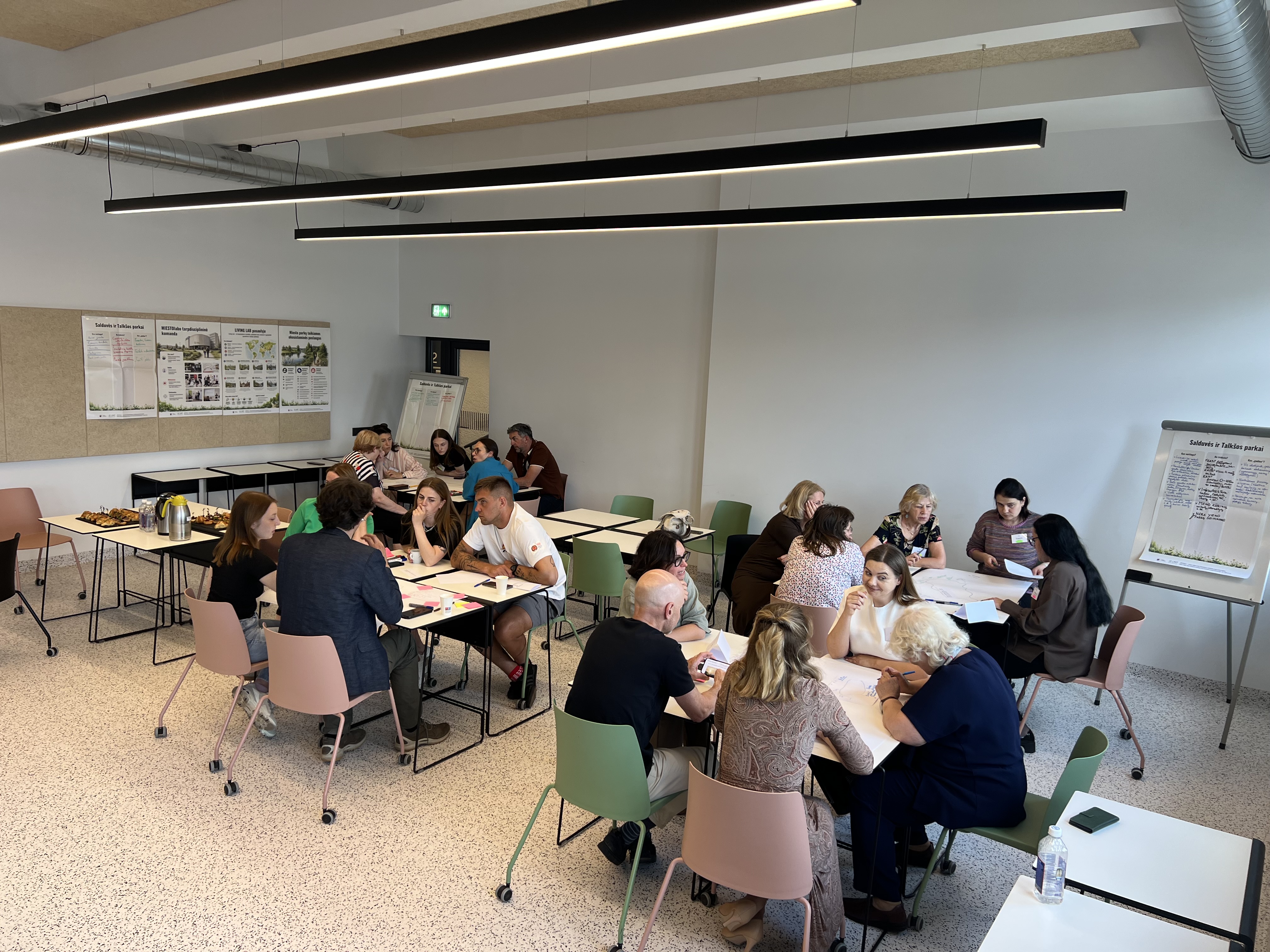
The activities of the Lithuanian Research Council-funded project “Co-creation of the Value of Urban Green Space Ecosystem Services in a Living Lab” (“MIESTOlabas”), implemented at Vilnius University Šiauliai Academy, are gaining momentum. Three Living Lab sessions have already taken place, bringing together representatives from different fields with a shared goal: to better understand the value of Talkša and Salduve Parks for the city, people, and nature, and to jointly explore directions for their sustainable development.
The Living Lab sessions gathered stakeholders concerned with the future of urban green spaces, including representatives of local government, academia, business, and other sectors, as well as local residents. The insights shared during the sessions may become a meaningful contribution to the implementation of the Šiauliai City Strategic Development Plan 2025–2033. Particularly important is the project’s aim to hear not only the voices of different social groups, but also the “voice” of nature itself – to understand what decisions are needed for urban ecosystems, biodiversity, and the long-term vitality of green spaces.
During one of the sessions, the Living Lab moved into the parks themselves. Together with Martynas Kazlauskas, Director of the Botanical Garden at Vilnius University Šiauliai Academy, participants observed the environment, analysed natural processes, and rediscovered urban nature. The meeting became a journey of discovery, revealing just how many ecosystem services urban green spaces provide on a daily basis.
Participants discussed the fact that parks do not only create opportunities for recreation, physical activity, or community gatherings. They also clean the air, cool the urban environment, protect biodiversity, contribute to emotional well-being, and create aesthetic and cultural value for the city. During the walk, discussions focused on beneficial and rare plant species growing in the parks, natural habitats, the water systems along the shore of Lake Talkša, and the birds nesting there.
This experience helped participants better understand that the concept of future parks cannot be developed solely with human convenience in mind. It is equally important to recognise and preserve what is already valuable: plant diversity, natural habitats, the uniqueness of the landscape, water bodies, and the living urban ecosystem.
Participants of the Living Lab discussed four possible development concepts for Talkša and Salduvė Parks. Discussions covered the vision of a recreational park, with a primary focus on leisure, sports, and wellness; a cultural park concept aimed at strengthening culture and urban and local identity; a natural or ecological park concept prioritising biodiversity conservation, nature awareness, and environmental education; as well as the possibility of a tourism-commercial park, viewed as an urban attraction offering services and entertainment while generating economic value for businesses and the city. These directions became the starting point for discussions on how to balance the diverse needs of people and nature.
The “MIESTOlabas” Living Lab is organised as part of the Lithuanian Research Council-funded research project “Co-creation of the Value of Urban Green Space Ecosystem Services in a Living Lab” No. S-MIP-24-18.
Project leader – Assoc. Prof. Dr Milda Damkuvienė