

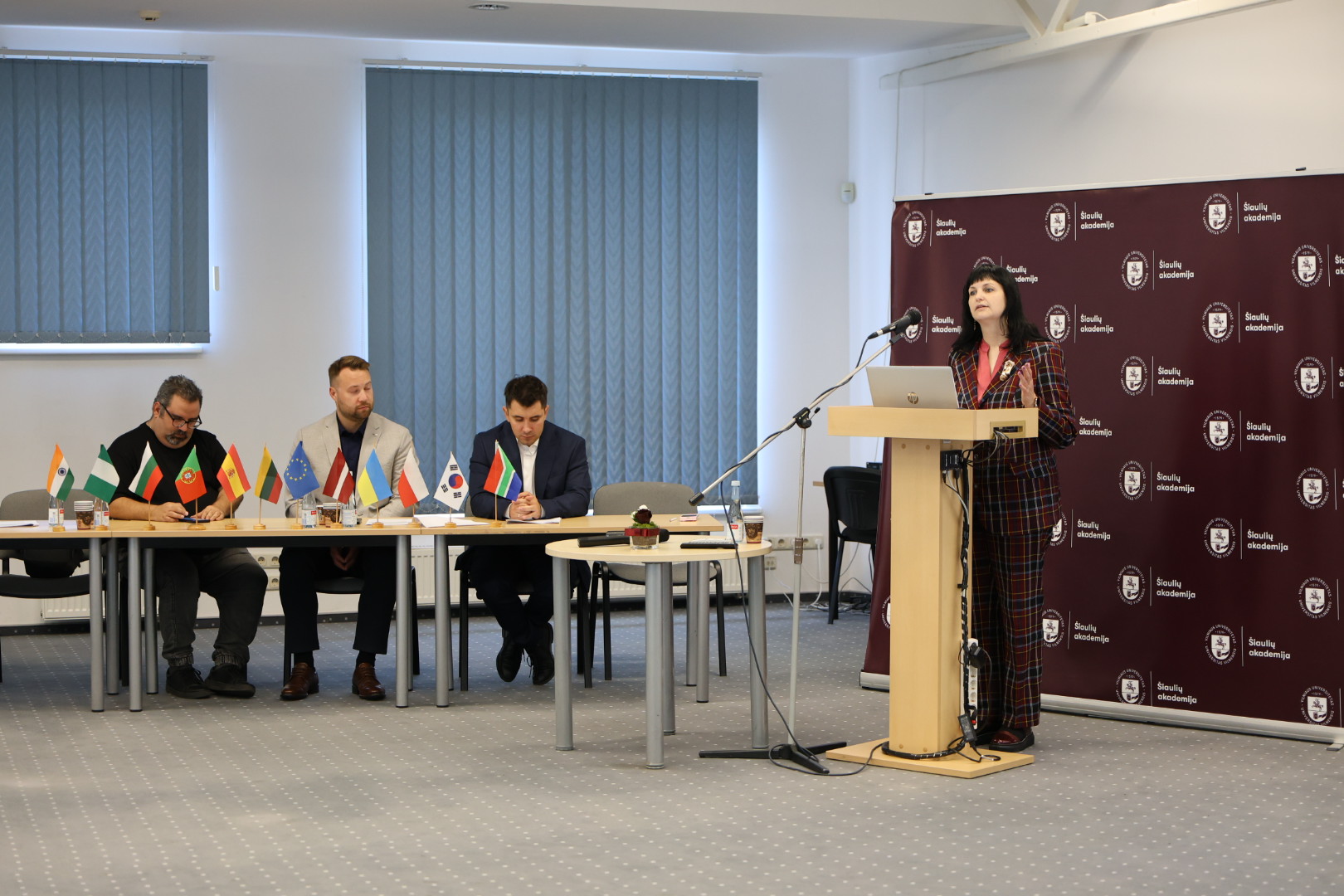
Is democracy eroding? How can states and societies remain resilient in the face of geopolitical uncertainty, technological change and growing security threats? What role does the state play today in fostering public trust, inclusion and the ability to adapt to change? These questions were at the heart of discussions at the 19th International Interdisciplinary Jonas Pranas Aleksa Scientific Conference, held on 9 October 2026 at Vilnius University Šiauliai Academy.
Held for the nineteenth time, this year’s conference invited participants to explore the theme “Eroding Democracy? Challenges to Security, Trust and Resilience in Times of Uncertainty”. Dedicated to the 147th anniversary of Professor Jonas Pranas Aleksa’s birth, the event brought together researchers from various academic disciplines, members of the academic community and public-sector representatives from Lithuania and abroad.
The conference was organised by the Institute of Regional Development at Vilnius University Šiauliai Academy, the Researchers’ Competence Network (RENET), the Institute of the Lithuanian Union of Scientists and the Ministry of the Interior of the Republic of Lithuania. This institutional collaboration reflects one of the event’s key principles: creating a space where scientific knowledge, practical experience in public governance and diverse perspectives can come together.
State Resilience Begins with Trust and the Ability to Adapt
The conference was opened with greetings from Prof. Renata Bilbokaitė, Director of Vilnius University Šiauliai Academy; Justinas Švėgžda, Vice-Mayor of Šiauliai; and Paulius Skardžius, Senior Adviser to the Public Administration and Local Self-Government Policy Group at the Ministry of the Interior.
The plenary session, moderated by Assoc. Prof. Vita Juknevičienė of Vilnius University Šiauliai Academy, focused primarily on the connections between democracy, public governance and societal resilience.
Dr Konstantinas Lotiuk, a researcher at Klaipėda University, examined the dilemma of democracy: how can resilience be strengthened without abandoning democratic values? Dr Justinas Staliūnas of Mykolas Romeris University explored resilience management in central government organisations under conditions of uncertainty.
Regional resilience was addressed by a team of researchers from Vilnius University: Dr Kristina Matuzevičiūtė-Balčiūnienė, Dr Ilona Bartuševičienė, Dr Irma Šileikienė, Dr Mindaugas Butkus, Greta Mockevičienė and Irmantas Pilypas. Their research, funded by the Research Council of Lithuania, raises a timely question: is regional resilience shaped by common factors across different regions, or does the specific context of each region ultimately matter most?
Dr Tomas Martinaitis of Vytautas Magnus University focused on the relationship between trust, adaptability and resilience in the context of smart governance in Lithuanian municipalities.
The plenary session also explored technological and cultural transformation. Dr Rainer Rubira-García of Rey Juan Carlos University in Spain and Prof. Rasa Pocevičienė of Šiauliai State College examined narratives and representations of artificial intelligence, as well as questions of identity in the European Union context.
The range of presentations demonstrated that state resilience cannot be understood solely as preparedness for crises. It is inseparable from democratic values, institutional capacity, public trust, technological competence and continuous learning.
From Geopolitical Threats to Citizen Participation and Local Governance
Following the plenary session, discussions continued in four thematic sections addressing a broad range of issues related to the transformation of states, societies and institutions.
The Researchers’ Competence Network (RENET) section, “Regional Challenges and Resilience,” brought together scholars examining political, social and economic challenges in different parts of the world. Topics included the energy resilience of Ukrainian regions during wartime and the role of social media in reinforcing anti-immigration narratives in Europe. Participants also analysed the relationship between political decision-making and merit-based reforms in Portugal.
The presentations highlighted that resilience is not merely a matter of national policy. It also depends on the capacity of regions to act, social solidarity, the information environment and institutional preparedness for long-term change.
The section “Participation, Inclusion and the Governance of the Future” focused on citizen participation, evidence-based decision-making and public engagement. Researchers explored the factors influencing public participation in the co-creation of ecosystem services in urban parks, future governance and evidence-informed policymaking, young people’s career choices, and the potential of creative methods—including LEGO® SERIOUS PLAY®—to encourage youth engagement.
The discussions particularly highlighted the need to find new ways for institutions to better understand public expectations and involve citizens in decision-making.
The section “Transformations of the State, Society and Institutions” addressed relations between Lithuania and the United States, changes in security and foreign policy, the state’s role in tackling complex environmental challenges, factors influencing the re-election of mayors, and the professional resilience of education workers. Participants also examined how digital transformation affects social behaviour, values and the competencies required of communication professionals.
The section “Democracy and Social Resilience” focused on cultural management, trust-building and empowerment in communities, forms of deliberative democracy, and public participation in local government decision-making. Presentations explored citizens’ assemblies, the potential of participatory budgeting and prospects for improving the role of local community representatives (seniūnaičiai). The programme also included a presentation of the Lithuanian Academy of Sciences’ monograph The Wealth of Lithuania’s Subsurface.
The topics discussed across the four sections demonstrated that the quality of democracy and societal resilience depend not only on decisions made at the national level. The capacity of local governments, active communities, open public institutions and meaningful opportunities for citizens to help shape decisions on matters that affect them are equally important.
International Academic Collaboration: More Than Presenting Research
This year’s conference brought together representatives of universities and research institutions from Lithuania and abroad. Its international dimension was strengthened by the participation of researchers from Spain, Portugal, Poland, South Africa, Ukraine and Latvia.
The hybrid format enabled researchers who were unable to travel to Šiauliai to take part in the event. Nevertheless, face-to-face academic exchange, informal conversations and opportunities to establish new collaborative relationships remained among the conference’s greatest strengths.
What distinguishes the conference is not the number of participants, but the quality of academic dialogue, the openness of its discussions and the community that has developed over many years. Researchers from different disciplines come together not merely to present their findings, but also to seek shared answers to complex questions facing the contemporary world.
Partnership between academia and the public sector is another important element of the conference. The Ministry of the Interior’s involvement in organising and participating in the event helps strengthen dialogue between academic research and public policy.
Nineteen Years of Academic Tradition: Looking Ahead to the Anniversary Conference
The 19th Jonas Pranas Aleksa Scientific Conference once again demonstrated that the vitality of an academic tradition depends not only on its continuity, but also on its ability to respond to emerging societal challenges. Over nearly two decades, the conference has brought together respect for Professor Jonas Pranas Aleksa’s scholarly legacy and contemporary discussions on state development, public governance, democracy and the future of society.
The 20th International Interdisciplinary Jonas Pranas Aleksa Scientific Conference is planned to take place in Šiauliai in October 2027. The organisers hope that the anniversary event will bring together an even broader community of researchers, public-sector representatives and partners, provide fresh impetus for collaborative research and further strengthen Šiauliai’s role as a centre for academic dialogue and international cooperation.
After all, cooperation, knowledge-sharing and the search for common solutions are essential to building stronger institutions, more resilient communities and a more sustainable future for the state.