

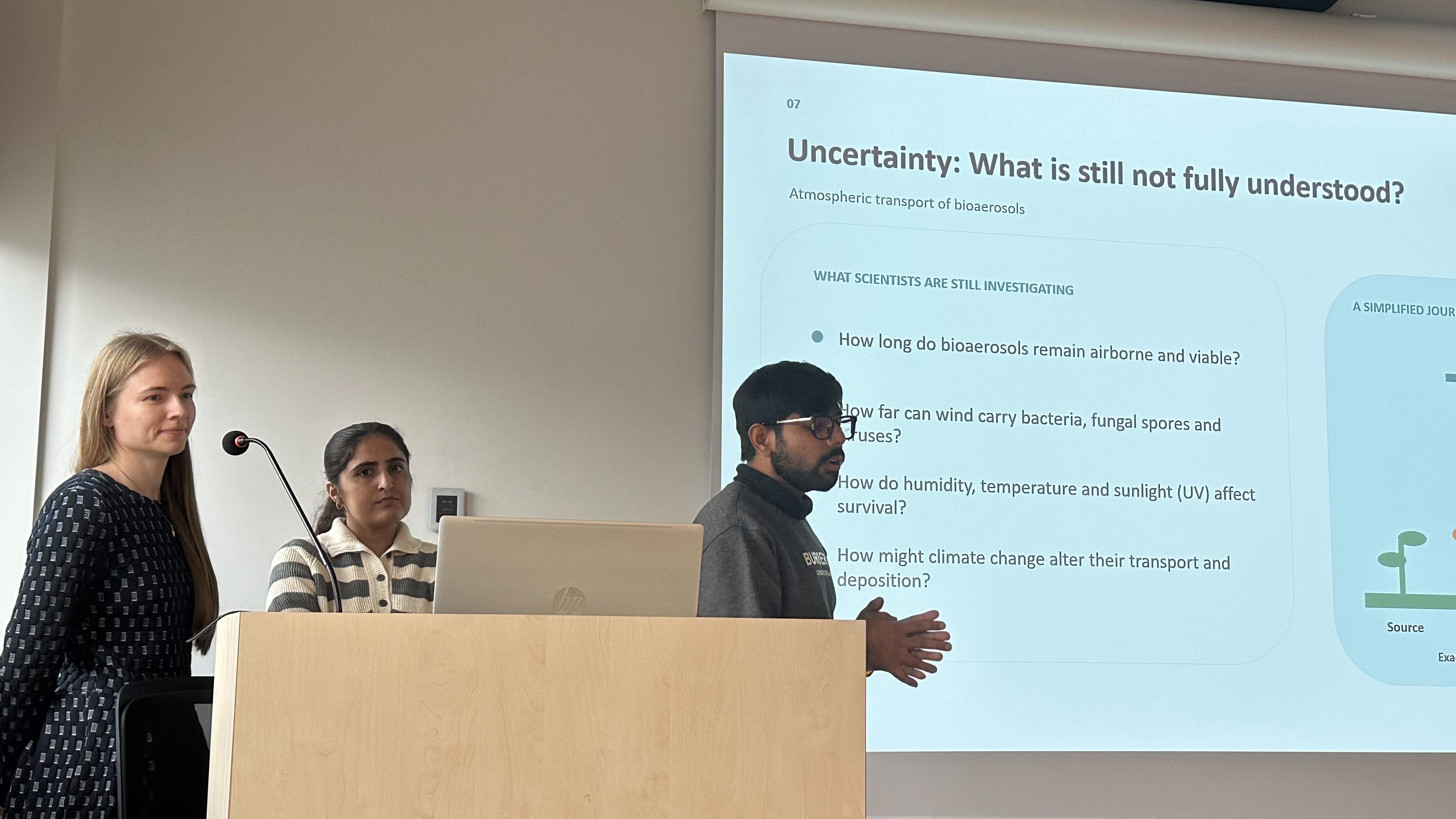
On October 14–15, the academic meeting “Climate meets life: exploring the living atmosphere” hosted at Vilnius University Šiauliai Academy brought together Master’s degree students from the Institute of Regional Development and the Institute of Geosciences. Over the two-day event, students from the “Natural Systems Management” and “Climate System Studies” study programmes explored the interactions between climate and the living environment—not only in the auditorium, but also in the laboratory and the Botanical Garden.
The meeting commenced with presentations and discussions led by the students themselves. Drawing on scientific publications, Master's students in Natural Systems Management from Šiauliai Academy analysed bioaerosol research, the dispersal of biological particles in the atmosphere, their links to meteorological and climate processes, and the scientific and practical applications of such research. Meanwhile, students of Climate System Studies contributed a different perspective to the joint discussion, focusing heavily on phenological observations, their interpretation, and the significance of long-term data in assessing environmental and climate change. By presenting experiences from various countries, students demonstrated how observing seasonal plant development can be a crucial source of information for climate change research and policy. The perspectives of different fields of study naturally complemented one another: ecologists examined biological processes through the lens of climate and meteorology, while climatologists viewed the atmosphere as a dynamic system driven by complex biological processes.
The theoretical part was enriched by lectures from researchers of the Environmental Research Group at VU Šiauliai Academy. Prof. Dr Ingrida Šaulienė presented the principles of aerobiological monitoring, identification of biological particles, bioaerosol diversity, and the associated risks to human health. Assoc. prof. Dr Laura Šukienė analysed the atmospheric transport of bioaerosol particles, their interactions with meteorological processes, and their potential role in atmospheric and climatic phenomena.
From theory, students transitioned to hands-on practice. The activities were linked to the AERIS project (No. 101236396), which places significant emphasis on monitoring biogenic and non-biogenic aerosols, integrating different measurement methods, and utilising modern atmospheric data. The discussions highlighted the value of real-time data, crucial not only for scientific research, but also for enabling more rapid environmental assessments, informing the public, and better understanding potential environmental and health risks. Visiting students from the Institute of Geosciences were introduced to aerobiological research conducted at Šiauliai Academy, to bioaerosol observation equipment, and to air sampling techniques. Students had the opportunity to observe firsthand how aerobiological observation equipment operates, how samples are collected, and what data can be derived from them. In the laboratory, students briefly stepped into the role of sample analysts: first learning to identify pollen in standard reference samples, and subsequently testing their acquired knowledge by analysing ambient air data from the aerobiological monitoring sample collection. This practical experience provided a comprehensive understanding of the entire research pipeline: from a particle entering the collector to data used in environmental monitoring and scientific research.
The topic of phenology extended beyond the auditorium into the VU Šiauliai Academy Botanical Garden, an active participant in International Phenological Garden networks. Here, students observed firsthand how phenological monitoring is conducted, which plant growth stages are recorded, and why long-term observation series are vital for assessing environmental change. Dr Martynas Kazlauskas, Head of the Botanical Garden, presented the garden’s collections, ongoing activities, and their value for academic studies and research. The two-day meeting concluded with an autumn walk through the plant collections accompanied by herbal tea from the Botanical Garden. The chilly weather only served to highlight the warm conclusion of the academic gathering, leaving ample time for informal discussion, reflections, and new ideas.
“Climate meets life” proved to be more than just the event's title. The meeting demonstrated that climate, ecology, phenology, and aerobiology cannot be examined in isolation—understanding a changing environment demands integrated expertise, data, and interdisciplinary approach.