

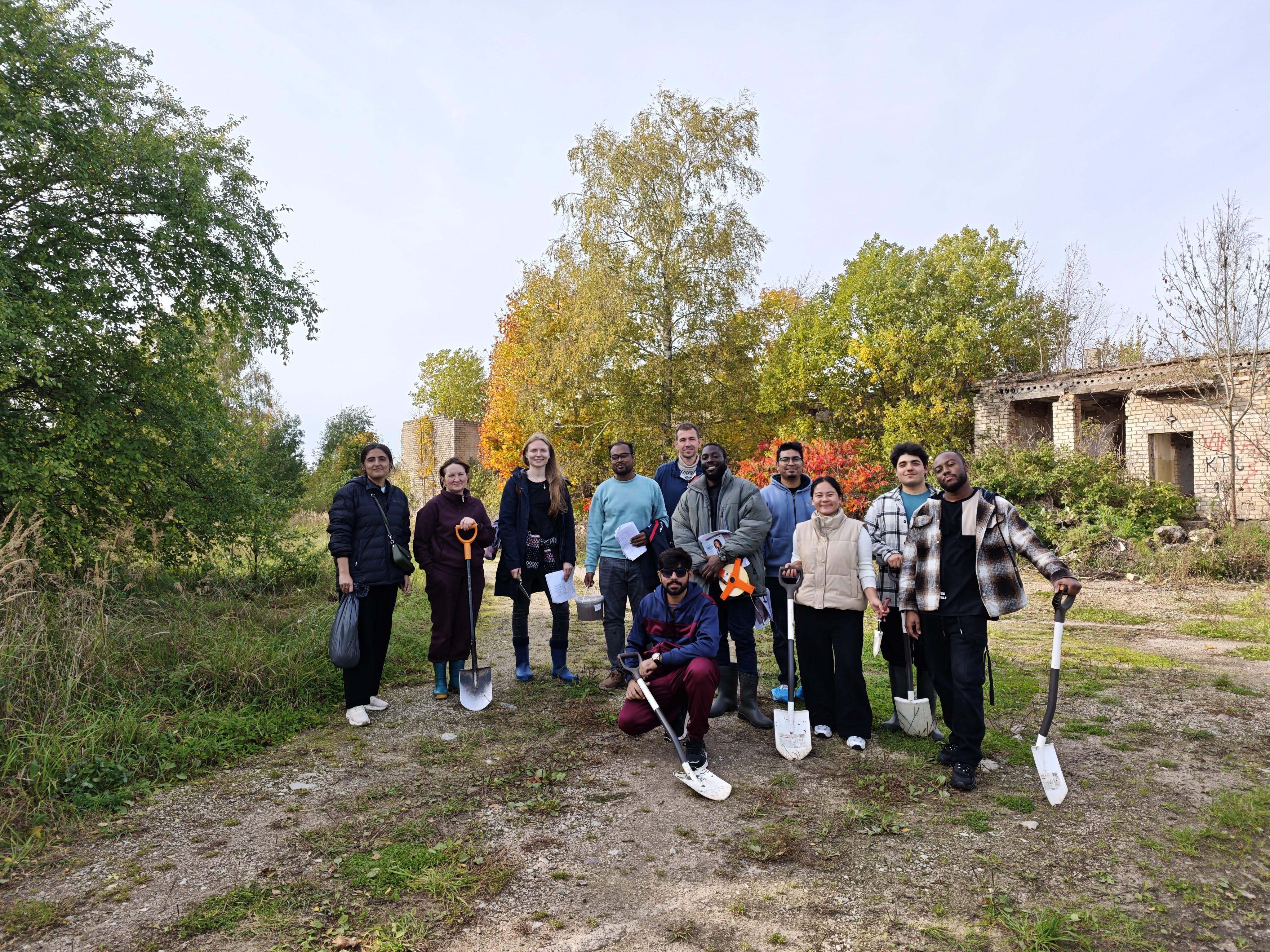
First-year students on the Master’s programme in ‘Natural Systems Management“ at Vilnius University’s Šiauliai Academy have actively participated in the activities of the international project ‘Remediation and Nature-Based Restoration of Degraded Industrial Sites, Promoting Local Community Awareness and Involvement in Zemgale and Northern Lithuania’.
The project involves long-term soil and biodiversity research aimed at assessing soil recovery and biodiversity trends following the restoration of sites in pilot areas in Lithuania (Žagarė and N. Akmenė Regional Parks) and Latvia (Aizkraukle Regional Park). The Šiauliai Academy of Vilnius University has a long history of collaboration with the Žagarė and N. Akmenė Regional Parks.
The students, accompanied by programme lecturers, visited Žagarė Regional Park. The students’ visit was coordinated by Urtė Šiaučiūnė, Senior Specialist at the Biodiversity Protection Division of the Samogitia Protected Areas Directorate of the State Service for Protected Areas. During the visit, the students learnt about the park’s structure, the history of Žagarė Manor and the nature conservation activities currently being carried out.
The students then explored one of the project’s study areas, where land management and restoration work is planned, along with the restoration of natural meadows with their characteristic vegetation. The Master’s students carried out a biodiversity assessment: they recorded the species composition of the vegetation, assessed the vegetation cover, identified non-native and invasive species, and analysed the distribution of species characteristic of natural meadows as well as the threat posed by invasive and undesirable species. During the fieldwork, the students were advised by Assoc. Prof. Dr Martynas Kazlauskas. They also collected soil samples from different depths and transported them to the Chemical Research Laboratory at Vilnius University’s Šiauliai Academy. Upon returning to the university, the researchers visited one of the largest and most pristine raised bogs in northern Lithuania, the Mūša Bog, which encompasses a telmological reserve protected under the Natura 2000 network. There, they explored the unique flora characteristic of Lithuanian peatlands, including insectivorous plant species, examined peat deposits, and gained deeper insight into the ecological and landscape features of this valuable wetland ecosystem.
In the laboratory, soil samples were prepared for further analysis; their moisture content was determined and various chemical analyses were carried out. Similar analyses were also conducted on soil samples collected from the Naujoji Akmenė Regional Park. Assoc. Prof. Dr. Ilona Kerienė advised the students on the methodology of the chemical analyses and the interpretation of the results, whilst Assoc. Prof. Dr. Laura Šukinė assisted with statistical data processing. Project activities will continue in the spring, when the active pollinator season begins. At that time, the students will carry out assessments of the species diversity and abundance of pollinating insects, which will supplement the project’s database and enable a more detailed evaluation of the links between soil properties and pollinator communities.
The students’ active participation, responsible approach to research and high level of motivation encourage the pursuit of even more ambitious results. Under the guidance of Prof. Dr Ingrida Šaulienė, the students are already taking the initiative to summarise the data collected during the project and to prepare a scientific publication together.
Participation in the project provides students with valuable practical experience, enabling them not only to master methods for studying the natural environment but also to develop skills in assessing ecosystem health, monitoring biodiversity changes, and contributing to the conservation and sustainable management of natural resources. Through active involvement in fieldwork, laboratory analyses, and data interpretation, students gain a deeper understanding of ecological processes and the importance of evidence-based environmental stewardship.